Regional Language Literacy 97.2% reading confidence
Numeracy skills are strong with 94% subtraction proficiency
Gender gaps reduced, confidence and skills improved
Community Impact
22,000 alumni in Aarambh Manch Life Skills Program
1,500 mothers in Literacy Program
7,50,000 family members enriched
Foundational Literacy & Numeracy Assessment
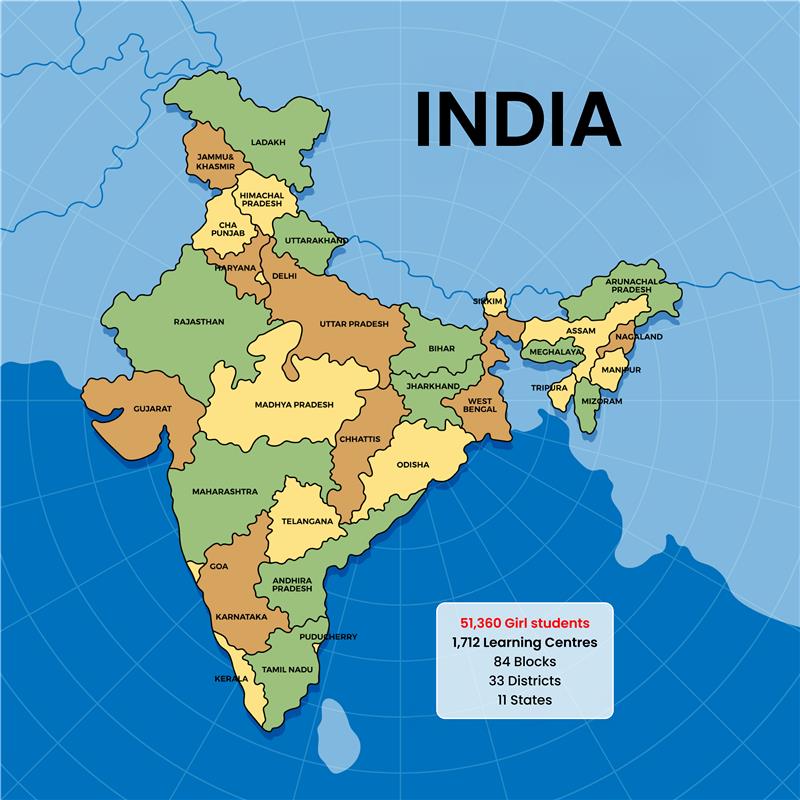
In May 2025, IIMPACT conducted an oral assessment across 11 states, evaluating 22,089 girls (Grades 3–5) using the ASER (Annual Status of Education Report) tool. The focus was on Foundational Literacy and Numeracy (FLN)—specifically reading, comprehension, expression, and basic arithmetic.
Regional Language Literacy
Strong literacy in Hindi, Bangla, and Odiya shown by 97.2% reading confidence and 91.5% expression skills.
Numeracy Proficiency
Numeracy skills are strong with 94% subtraction proficiency and 69% proficiency in division skills.
English Literacy Gaps
English literacy shows gaps with only 57.7% reading proficiency and 39% able to express thoughts clearly.
Focus on Interventions
Need targeted support in English comprehension and ongoing support for numeracy and regional language strengths.
Quarterly Assessment Reports
IIMPACT runs teacher training four times a year. Every quarter, we assess the students as well as teachers in every Learning Centre and publish the results in our quarterly reports, sent out to every sponsor.
From time to time, our corporate sponsors commission performance assessment reports that they share with us. Here are a few reports courtesy of the companies named:
The academic and field research is now well-established to support the notion that:
“Investment in girls’ education may well be the highest-return investment available in the developing world.”
(Larry Summers, when Chief Economist at the World Bank).
Leveraging Girl Child Education
Former World Bank President, James Wolfensohn, addressing the Fourth UN Conference on Women, said:
“Education for girls has a catalytic effect on every dimension of development: lower child and maternal mortality rates; increased educational attainment by daughters and sons; higher productivity; and improved environmental management. Together, these can mean faster economic growth and, equally important, wider distribution of the fruits of growth…. More education for girls will also enable more and more women to attain leadership positions at all levels of society: from health clinics in the villages to parliaments in the capitals. This, in turn, will change the way societies will deal with problems and raise the quality of global decision making.”
Gender Disparity in India
In India, there are 1,020 females for every 1,000 males, and the gender parity index is 0.49. Male literacy in India is 84%, while female literacy is 70%. However, there are significant gender differences in literacy rates, particularly in rural districts. According to the National Sample Survey Office’s 75th round household survey in 2017-18, there are 32.2 million out-of-school children in the age group of 6 to 17 years in India, with more than 75% estimated to be girls. The UNESCO Institute for Statistics indicates there were approximately 5 million girls out of school in India.
These insights from global leaders underscore why investing in the girl child's education is not just morally right but economically smart - creating ripple effects that transform families, communities, and nations.